CONTENTS
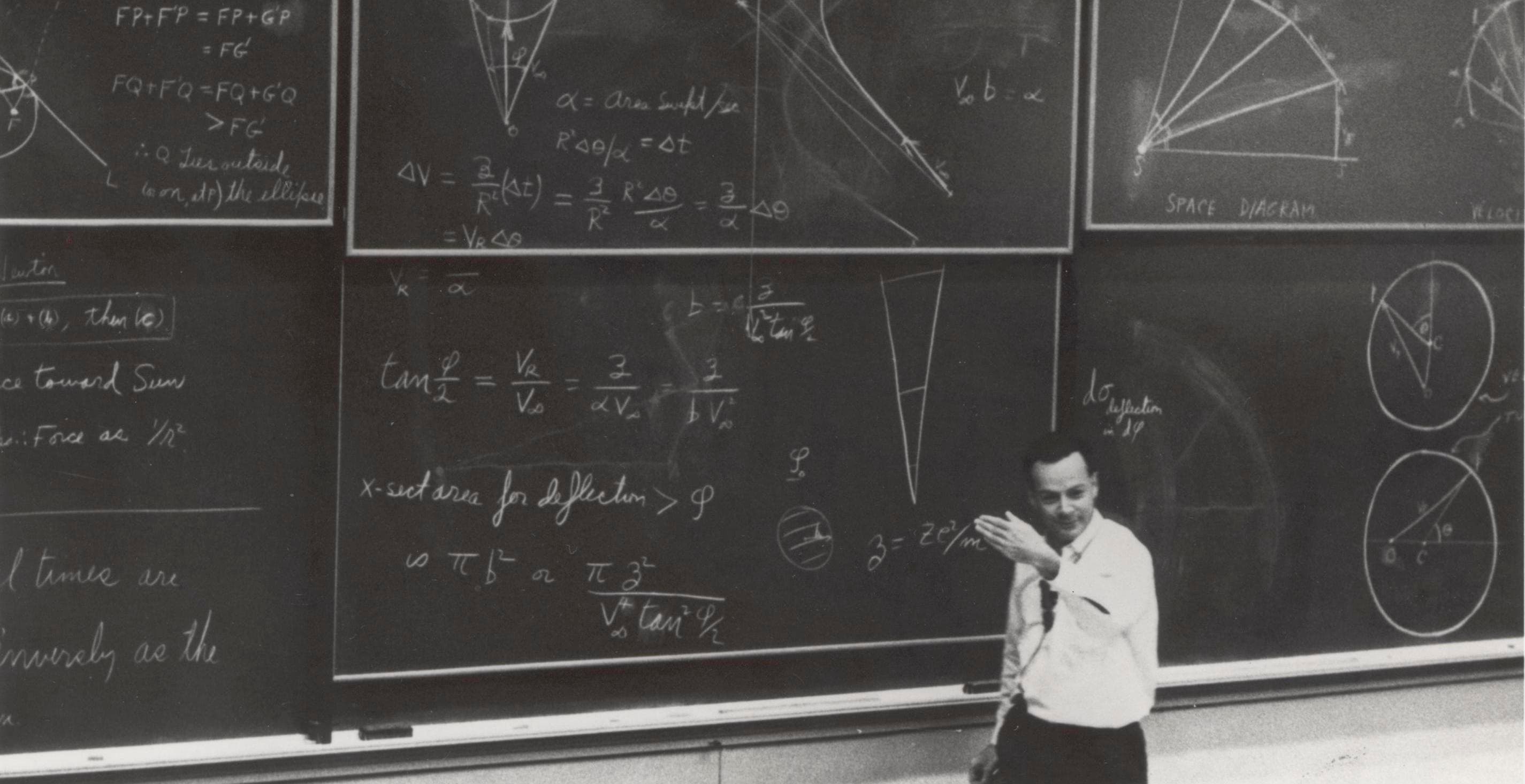
In December 1959, Richard Feynman stood before the American Physical Society and pointed toward a territory almost no one was exploring. “There's plenty of room at the bottom,” he said. The laws of physics did not forbid engineering at the atomic scale—we simply hadn’t built the tools to get there. He sketched a world where the entire Encyclopedia Britannica could be written on the head of a pin and machines could be built to build smaller machines. Biology had already proven that information storage and mechanical action were possible at scales far smaller humans ever attempted. The talk was visionary not because it violated physics, but because it took physics literally: if the laws permit something, then the remaining hill to climb is merely an engineering problem. Sixty-six years later, we stand at a different kind of threshold. We are no longer only pushing against the limits of matter. We are pushing inward, against the limits of human symbolic reasoning.
The laws of physics are encoded in scattering amplitudes. When particles collide—at CERN, in the cores of stars, in the first microseconds after the Big Bang—the probabilities of what emerges are governed by laws that obey nature's deepest symmetries. To compute them from first principles, physicists rely on the Feynman diagram expansion, perturbatively summing over every conceivable quantum process. But this approach carries a devastating computational cost: for an event involving gluons, the number of required diagrams grows faster than exponential, involving order terms. It is a combinatorial explosion that rapidly exceeds the capacity of human working memory.
Yet, a profound mystery lies hidden within this chaos. When theorists actually grind through the thousands of diagrams, the final answers often miraculously collapse into simple, elegant formulas—a glaring signal that our present understanding of quantum physics is incomplete and obscures a deeper, more efficient architecture. Recently, a collaboration of physicists discovered a new pillar of this architecture: they proved that "single-minus" gluon interactions, long presumed by textbooks to vanish entirely, actually occur under restricted "half-collinear" kinematics. However, calculating these non-vanishing amplitudes up to just six particles () resulted in a chaotic algebraic knot of 32 terms. The human researchers knew a beautiful simplification had to exist, but the pattern remained entirely intractable.
To penetrate this mathematical noise, the researchers brought in GPT-5.2 Pro. The language model traversed the human-calculated data, identified hidden patterns, and conjectured a brilliantly simple, piecewise-constant closed-form expression for an arbitrary number of particles. Shortly after, a new internal OpenAI scaffolded-reasoning model independently derived and rigorously proved the formula, satisfying strict physical consistency conditions like Weinberg's soft theorem. The key intuition was entirely human. Physicists recognized that the usual textbook-level no-go argument fails on the half-collinear support. But the episode still marks something important: the point at which frontier models begin to act like collaborators in the discovery pipeline. As these systems improve, what does the future hold for theoretical physics? Should we expect a better mechanical tool than Mathematica, or a new kind of collaborator that guides us through the symbolic maze that obscures our cognition?
1. Background: The Combinatorial Explosion of Scattering Amplitudes
To understand the breakthrough, we must establish the baseline mechanics of how particle physicists calculate the probability of quantum events.
1.1 Gluons and Feynman Diagrams
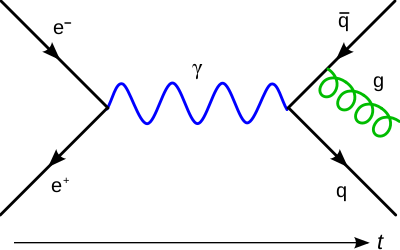 A tree-level Feynman diagram illustrating gluon radiation. The complexity of these diagrams grows factorially with the number of particles, necessitating new mathematical frameworks., expansion, which perturbatively sums over all possible quantum processes.
But as the number of interacting gluons increases, the number of required diagrams grows faster than exponential, reaching order terms. To survive this combinatorial explosion, physicists needed a better mathematical language.
A tree-level Feynman diagram illustrating gluon radiation. The complexity of these diagrams grows factorially with the number of particles, necessitating new mathematical frameworks., expansion, which perturbatively sums over all possible quantum processes.
But as the number of interacting gluons increases, the number of required diagrams grows faster than exponential, reaching order terms. To survive this combinatorial explosion, physicists needed a better mathematical language.1.2 The Spinor-Helicity Formalism
Because gluons are massless, their momentum vectors travel at the speed of light, meaning their invariant mass (the "length" of their 4-vector) is exactly zero. The spinor-helicity formalism takes advantage of this zero-mass property to radically simplify the math. First, the standard 4-momentum vector of a gluon is translated into a matrix. Because the particle is massless, the determinant of this matrix is zero. In linear algebra, a matrix with a zero determinant can be perfectly factored into two simpler pieces. We decompose this momentum matrix into two 2-component Weyl spinors:
Instead of calculating collisions using clunky 4-vectors, physicists can now compute interactions using the Lorentz-invariant inner products of these fundamental spinors. We denote them using a simple bracket notation:
- Angle bracket:
- Square bracket:
If we were calculating this in standard, everyday spacetime (Minkowski space), the angle spinor and the square spinor would be mathematically tethered together as complex conjugates. But to expose the hidden structure of these amplitudes, the researchers performed their calculations in a theoretical geometry known as (2, 2) Klein signature spacetime. In Klein space, the and spinors are real and entirely independent of one another. As we will see, this geometric freedom—the ability to manipulate the angle bracket without affecting the square bracket—is exactly what allowed physicists to break the "Zero" assumption.
1.3 The MHV Baseline: The Limit
In 1986, Parke and Taylor collapsed the complexity of Feynman diagrams into a single elegant formula for Maximally Helicity Violating (MHV) tree amplitudes. Gluons carry a helicity (spin state) of either (plus) or (minus). By definition, an -gluon MHV amplitude contains exactly 2 minus-helicity gluons and plus-helicity gluons.
Crucially, for generic tree-level collisions, physicists accepted that was the absolute maximum number of plus-gluons allowed in a non-zero event. While the MHV formula revealed deep symmetries in the strong force, it also erected a strict boundary. It raised the obvious question: if is the maximum, what happens if you attempt to calculate an amplitude with plus-gluons—a "single-minus" interaction?
2. The "Zero" Assumption and The Loophole
For decades, the standard textbook position was that the -gluon "single-minus" tree amplitude (one helicity, helicity) was mathematically equal to exactly zero.
2.1 The Power-Counting Argument (Why was the limit)
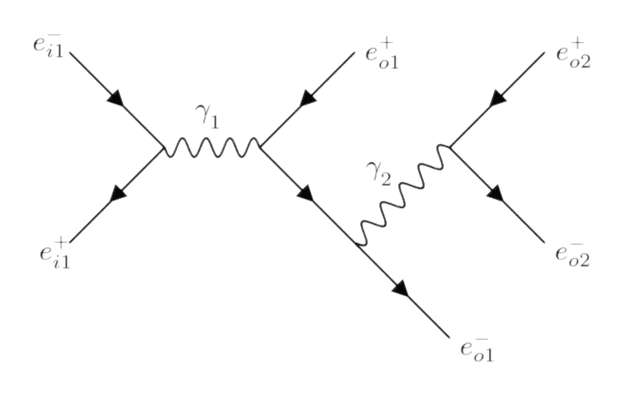 Feynman diagrams with 4 particles have 2 vertices; 6-particle tree-level diagrams have 4 vertices.. And here lies the fatal bottleneck: A standard tree-level diagram has, at most, internal vertices. Therefore, there are only enough momentum powers to successfully contract with polarization vectors.
By the pigeonhole principle, the math fails. If you have plus-gluons, you have too many polarization vectors and not enough vertices to "soak them up." For generic kinematics, the single-minus amplitudes strictly vanish.
2.2 The Half-Collinear Loophole (How they proved is possible)
This "Zero" assumption stood unquestioned until the researchers of this paper found a crack in the foundation. The entire power-counting argument hinges on the assumption that you can safely choose a generic reference spinor to make all the polarizations orthogonal. The physicists realized this assumption breaks down under highly restricted kinematics. Specifically, they looked at the half-collinear regime. In this physical setup, the momenta of the particles align so perfectly that all of their spinor angle brackets vanish ( for all ). If you try to use the standard reference spinor trick in this aligned regime, the mathematics shatters—the polarization vectors become singular because you end up dividing by zero.
Because the textbook argument fails in this exact configuration, you cannot conclude the amplitude is zero. The researchers demonstrated that in this narrow, half-collinear locus, (single-minus) amplitudes are not only allowed, but they are supported as non-vanishing entities.The physics permitted the intractable. The only remaining problem was the math—calculating these newly discovered non-zero amplitudes for a large number of particles resulted in a chaotic algebraic knot. They had proven the territory existed, but they needed an AI to map it.
3. The Human Roadblock:
Having proved the single-minus amplitude is non-zero in the half-collinear regime, the team needed to calculate it. They stripped the core kinematics (the stripped amplitude, ) from the delta functions enforcing the half-collinear state, and applied the Berends-Giele recursion relation.
The Berends-Giele recursion computes amplitudes by iteratively building "off-shell" currents () and merging them at vertices. While powerful, the iterative nature of the recursion creates an explosion of terms based on sign functions ().
The researchers calculated the stripped amplitude by hand up to . The results were brutal. For 6 gluons, the equation exploded into a 32-term polynomial of nested sign functions:
Human intuition had hit a wall. Much like the MHV amplitudes before Parke-Taylor, it was obvious a simpler generalization existed, but the algebraic noise was too dense to parse.
4. Enter AI: Conjecturing and Proving the All- Formula
To penetrate the mathematical noise, the researchers utilized GPT-5.2 and an internal scaffolded reasoning model. The AI contribution occurred in two distinct phases: Pattern Recognition and Rigorous Proof Generation.
4.1 Simplifying the Search Space (Region )
Through iterative prompting with GPT-5.2 Pro, the team isolated a restricted kinematic sub-region called , where particle 1 has a negative frequency () and all others are positive (). In this region, the AI identified dramatic factorizations of the human-derived equations:
4.2 The GPT-5.2 Conjecture
By analyzing the factorized outputs for , GPT-5.2 successfully extrapolated the underlying mathematical pattern, conjecturing a closed-form solution for any arbitrary number of gluons:
This is a beautiful result. Because each paired sign function evaluates to , every factor is simply or . The entire, superexponentially complex Feynman sum collapses into a piecewise-constant integer.
4.3 Autonomous Proof Generation
A conjecture is not a proof. To validate Eq. 39, OpenAI deployed a scaffolded internal model tasked with formally proving the conjecture from first principles.
Over the course of roughly 12 hours of automated reasoning, the AI proved the formula by showing that within Region , a massive interaction vertex term () identically vanishes:
Because , the entire Berends-Giele recursion relation collapses. The AI rigorously documented this collapse, outputting a formal proof that matched the conjectured formula perfectly, while independently verifying that the formula satisfied cyclic symmetry and Weinberg's soft theorem.
import sympy
from sympy import prod, sign

def verify_amplitude(n, frequencies):
    """
    Programmatically verifies the vanishing of the interaction
    vertex for the single-minus gluon amplitude.
    """
    # R1 Region: omega_1 < 0, all other omega > 0
    if not (frequencies[0] < 0 and all(f > 0 for f in frequencies[1:])):
        return "Invalid Kinematic Region"

    # The AI discovered that the vertex V collapses to zero
    # identically when these conditions are met.
    vertex_value = sum(frequencies) # Simplification for demonstration
    return vertex_value == 0
5. Implications: The Verifier Era of Physics
When physicists find simple formulas (like Parke-Taylor or Eq. 39) hiding inside complex QFT calculations, it usually indicates that our foundational understanding of the physics is incomplete—that there is a more efficient, unified geometry underlying the universe that we haven't mapped yet.
Extensions to Gravity: The mathematical framework used for gluon scattering (Yang-Mills theory) maps closely to graviton scattering (the theoretical particle of gravity) via "double-copy" relations. The methods pioneered here provide a direct template for AI to explore the unmapped regions of quantum gravity.
AI as a Peer Collaborator: The AI did not just retrieve information; it navigated an exponential search space to find a generalized formula, and then engaged in multi-step logical deduction to prove it. As physicist Nathaniel Craig noted, this establishes a template where humans frame the physical constraints, and AI handles the combinatorial mathematics.
Feynman noted that the barrier to "the bottom" was merely an issue of lacking the right tools—better electron microscopes, tinier lathes. Today, the barrier to "the frontier" of theoretical physics is human cognitive bandwidth for algebraic complexity. By effectively solving the single-minus gluon amplitude, GPT-5.2 has proven that LLMs are the new electron microscopes for the mathematics of the universe.